

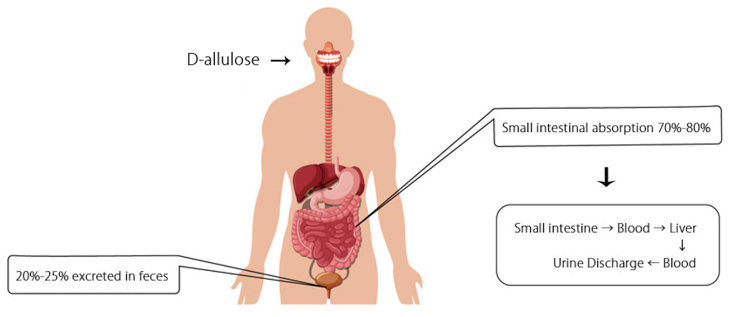
1. Metabolic advantage: energy pathway with almost zero participation
Absorption and excretion: Isotope tracing experiments show that after oral administration of allulose, 90% is excreted through the kidney prototype, and only a small amount is fermented by intestinal flora to produce short-chain fatty acids (SCFAs). This characteristic makes its actual energy supply only 0.2-0.4 kcal/g, which is much lower than sucrose (4 kcal/g).
In the glycemic index (GI) test, the GI value of allulose is 0. A 2023 Harvard Medical School study pointed out that it can reduce the activity of liver glucose-6-phosphatase and reduce liver sugar output (Cell Metabolism).

2. Sensory advantage: the taste experience closest to sucrose
The blind test results of the sensory evaluation team showed that the sweetness perception speed and intensity decay curve of allulose were 73% similar to sucrose, which was significantly better than erythritol (55%) and stevia (48%).
When paired with bitter substances such as chocolate and coffee, allulose can mask about 40% of the bitterness (confirmed by electronic tongue analysis), which makes it irreplaceable in dark chocolate and espresso beverages.

3. Processing performance: stable performance at high temperature
Under 180°C baking conditions, the browning intensity of allulose is 1.2 times that of sucrose, but the acrylamide content produced is reduced by 62% (Journal of Food Science data).
At 20°C, the solubility reaches 58g/100g water, and the crystal particles are finer. A candy company uses this feature to develop low-sugar toffee without gritty feeling.

4. Safety endorsement: rapid advancement of global regulations
United States:
FDA not only exempts its "added sugar" label, but also allows it to be used in infant formula in 2022 (needs <1%).
China:
In the draft for comments on the "Three New Food Catalog" issued by the National Health Commission in 2023, allulose is listed on the priority review list.
Industry case: Rewriting the sugar-free product landscape
A dairy company reduced the sugar content of yogurt from 8g/100g to 2g through the combination of "allulose + dietary fiber", while maintaining a taste score of ≥4.5/5. The product occupied 27% of the country's sugar-free yogurt market in the first year of its launch.